Music audition guide · Europe
Conservatorium van Amsterdam Entrance Exam Guide
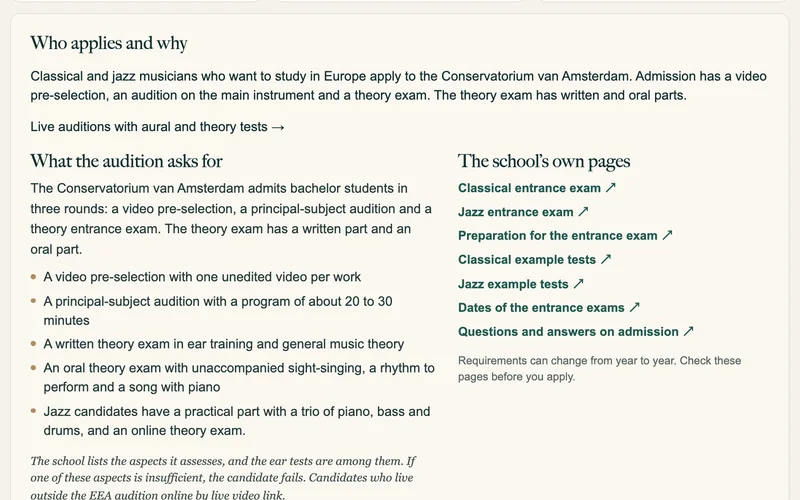
The Conservatorium van Amsterdam (CvA) admits classical bachelor students in three rounds. They are a video pre-selection, an audition on your principal subject and a theory exam. Your principal subject is your main instrument, voice or composition. The CvA publishes example tests, so you can see the level of the theory exam before you apply.
 Start Conservatorium van Amsterdam audition practicePractice the parts of the audition in order. Each part explains what the panel listens for.Open
The Music Stem is not affiliated with the Conservatorium van Amsterdam.
The video pre-selection
You add links to your videos on YouTube or Vimeo in the application form. Each principal subject sets its own repertoire. The rules for the videos are the same for every subject:
- The camera stays still and shows your hands and your face.
- Each piece has its own video.
- The recordings are not edited.
Composition applicants send a portfolio and a letter of motivation.
The principal-subject audition
You perform a program of about twenty to thirty minutes, which you send to the CvA beforehand. The panel judges how well suited you are to the subject. Classical candidates are given a répétiteur, a pianist who accompanies them, and can rehearse their pieces together on the exam day. Composition applicants do not perform. They have an interview.
Candidates who live in the European Economic Area (EEA) audition at the CvA in Amsterdam. The EEA is the countries of the European Union with Iceland, Liechtenstein and Norway. Candidates who live outside the EEA audition online by live video link. Recordings are not accepted for this round. Conducting auditions are always held in Amsterdam. For an online audition, use a good microphone and a reliable internet connection.
You hear the result straight after the audition. If you pass, you go on to the theory exam. Passing the audition is not yet a place.
The theory exam
Only candidates who pass the audition take the theory exam. It is usually on the day before or the day after the audition. Candidates who audition in Amsterdam should plan to stay at least two days. Candidates who audition online take the theory exam online.
- The written part has a test of ear training and a test of general music theory.
- The oral part has unaccompanied sight-singing, the performance of a rhythm and a song that you sing with piano accompaniment.
The CvA's classical example tests show the kinds of question. The ear training test includes melodic, rhythmic and two-part dictation and the hearing of triads. The general theory test covers scales, intervals, triads, seventh chords, keys and meter.
How the CvA decides
The panel judges the level of your repertoire, your technical skills, your artistic ability, your potential to develop and your ear. The CvA states that if one of these is not good enough, the candidate fails. The final decision takes three things into account:
- your practical and theory results
- your English, if you come from abroad
- the number of places in each section
Being admissible does not guarantee a place. A candidate who fails cannot try again in the same year.
The jazz entrance exam
Jazz applicants upload a link to a recording with the application. The exam has two parts on two days in a row.
- The practical part. The CvA provides a trio of piano, bass and drums. You have twenty to thirty minutes to rehearse with it before the exam. Jazz pianists may bring their own bass player and drummer.
- Tasks for jazz pianists. The panel may ask you to repeat lines and chords by ear and to accompany a simple new piece by ear. It may also ask you to play a piece from a melody with chord symbols and to improvise on a given melody.
- The theory part. It is held online. It has an ear test of short rhythmic, melodic and harmonic fragments. It also has a test of general theory in scales, intervals, triads, chords and keys. The CvA says you do not need to answer every question correctly to be admitted.
How to prepare
Work through the example tests. Download the CvA's example tests and take each one with a time limit. Mark your answers with the answer sheets where the CvA provides them. Note which kinds of question cost you the most points.
Melodic dictation. The classical test gives you the first note. Before you write, find the tonic from that note and sing the melody back in your head. Write the rhythm first, and add the pitches afterward.
Dictation in two parts. Listen to the bass line on its own on the first hearing. Write the voice you hear most clearly first. Fill in the other voice on the later hearings.
Triads by ear. Learn to hear major, minor, diminished and augmented triads. Learn also whether each one is in root position or in an inversion. Sing the bottom note of each chord you hear, and then sing the whole chord from the bottom up.
Sight-singing without a piano. The sight-singing in the oral part is unaccompanied. Practice new melodies away from any instrument, and check your last note on a keyboard afterward.
Rhythm. Read rhythms aloud on one syllable with a metronome. Include triplets, dotted notes, ties and syncopation in both simple and compound meters.
The song with piano. Learn the song from the example test, or one like it, with a pianist. Sing it in the original language with clear diction.
Practice on The Music Stem
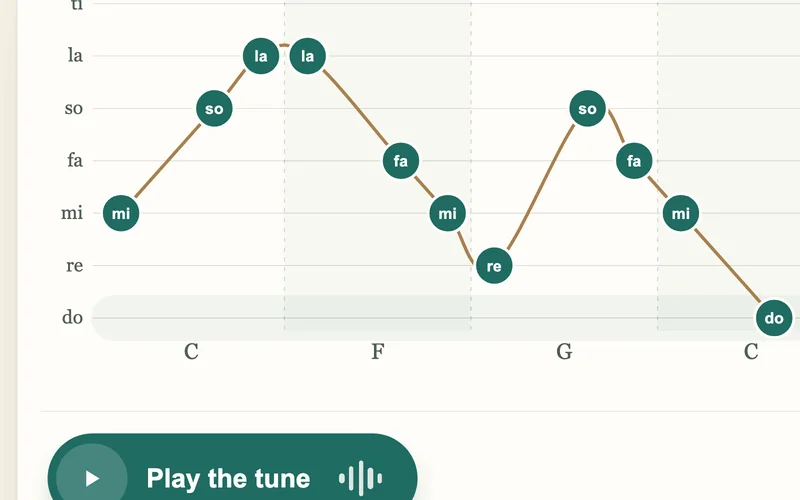 Melodic dictationMelodic dictation trains the melodic dictation in the example tests. Each melody starts from a given first note.Open →
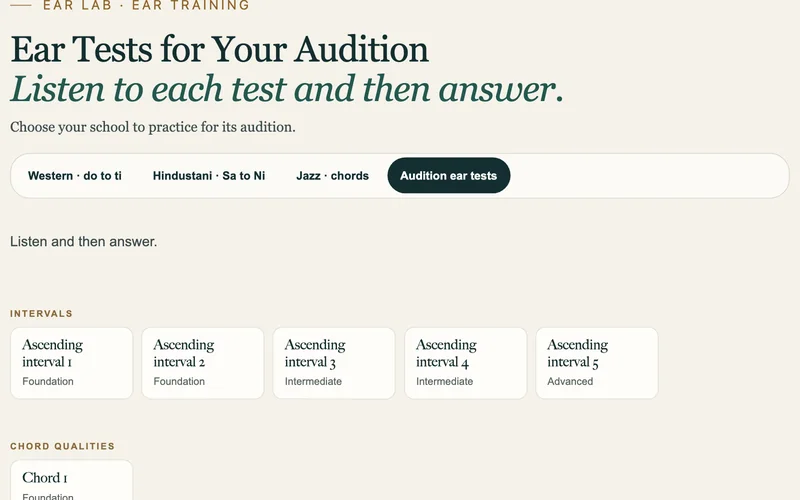 Ear tests for auditionsEar tests for auditions train your ear for the triads and intervals in the written part.Open →
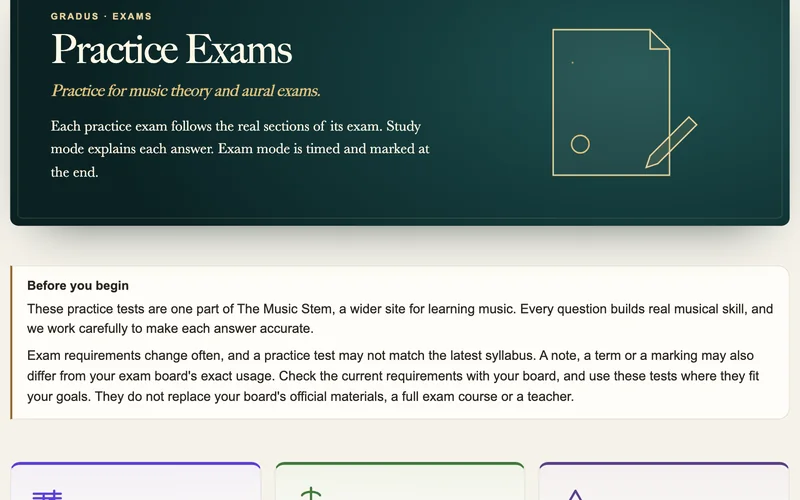 Music theory practice testsMusic theory practice tests cover the scales, intervals, triads and keys of the general theory test.Open →
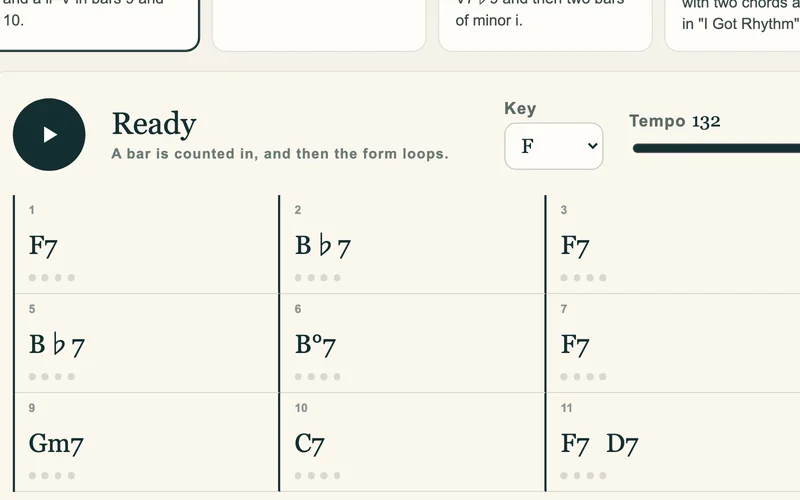 Improvisation practiceImprovisation practice gives jazz applicants backing to improvise over.Open →
- Conservatorium van Amsterdam practice has two-part dictation and rhythm reading in the style of the theory exam.
The CvA's own pages
Formats can change from year to year. Read the CvA's own pages before you apply. Our practice follows the style of the published example tests, and it is not a CvA test.