The Music Stem / Music theory practice tests / GACE Music 723
Exam practice
GACE Music (P–12) (723) practice test
Timed practice for GACE Music 723, set out in the board's own sections. Every answer comes with an explanation.
A question from this exam
This is one of the free questions in the practice test. Answer it here and read the explanation.
Listen to the tonic chord and then a short chorale phrase. Which cadence ends the phrase?
The practice test follows the exam board's sections, and every answer is explained. The test has 87 questions.
Start the practice test →About the exam
GACE Music (P–12) (723) is a licensure test for music teachers, owned by the Georgia Professional Standards Commission.
This practice test covers aural skills, theory and composition, education and performance, and history, for Georgia music teachers.
Who takes it and why
Future music teachers in Georgia take it for state certification. Its full name is GACE Music (P–12).
What this practice test covers
The listening questions use our own piano recordings. They cover intervals, chords, cadences, meter, texture, finding errors against a printed score and judging a piano performance. Each error question plays a single melody. Performance questions judge tempo, balance, dynamics and articulation on the piano. Recognizing a style, period, instrument or voice by ear is not included. Intonation, blend, tone and diction are not included either.
The sections
- Section 1 · Aural Analysis SkillsOn the official test this is a separately timed part of 30 questions in 45 minutes.This section has 17 questions.
- Section 2 · Composition and Music TheoryOn the official test this is a separately timed part of 20 questions in 30 minutes.This section has 20 questions.
- Section 3 · Music Education and PerformanceOn the official test this is a separately timed part of 30 questions in 45 minutes.This section has 30 questions.
- Section 4 · Music History and CultureOn the official test this is a separately timed part of 20 questions in 30 minutes.This section has 20 questions.
Timing
Exam mode runs a clock of 2 hours 30 minutes for the whole practice test.
The full practice test holds 87 questions.
Study mode has no clock. It checks each answer as you go.
Sample questions
Sample 1
In an Orff-based lesson, students create a two-measure pattern and repeat it under a song. What is the pattern called?
- Canon
- Ostinato
- Coda
- Cadenza
The answer is B, Ostinato.
Ostinato means a short figure repeated throughout a passage, a basic layer in Orff accompaniment. A canon imitates the melody at a time interval. A coda ends a piece. A cadenza is a solo display passage.
Sample 2
A kindergarten class needs an untuned percussion instrument that rings for a long time at the ends of phrases. Which instrument fits?
- Triangle
- Woodblock
- Claves
- Guiro
The answer is A, Triangle.
A triangle struck while hanging freely rings for several seconds. The woodblock and claves give short, dry clicks. The guiro is scraped and makes a rasping sound that stops when the scraping stops.
Sample 3
Which description best fits the field of ethnomusicology?
- The study of non-Western music using Western notation alone
- The study of music in its cultural context that often relies on fieldwork
- The history of European concert music as traced through its scores
- The science of how instruments produce and project sound
The answer is B, The study of music in its cultural context that often relies on fieldwork.
Ethnomusicologists study any music, including Western traditions, as part of human culture. Fieldwork with participant observation is a central method, and Alan Merriam described the field as the study of music in culture.
Certificate of Completion
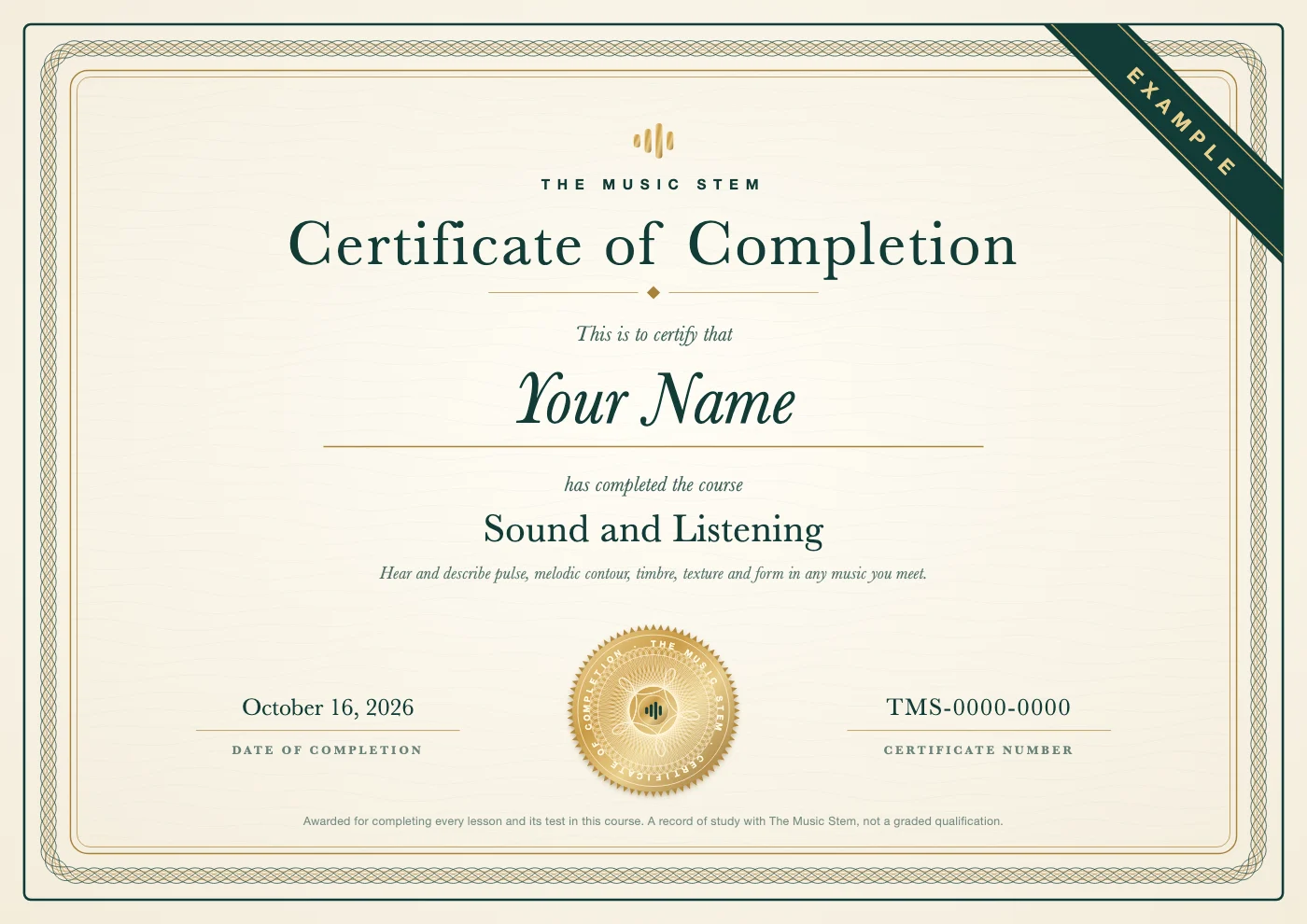
Each course on the site ends with a Certificate of Completion. You earn it when every lesson in the course is complete. You earn a Certificate of Practice for a full practice paper when you answer all its questions in Exam mode.
See the courses →Questions and answers
How long is the GACE Music 723 practice test?
Exam mode gives 2 hours 30 minutes for the whole practice test. It holds 87 questions. Study mode has no clock.
What sections does the GACE Music 723 practice test cover?
It follows the board's order: Aural Analysis Skills, Composition and Music Theory, Music Education and Performance and Music History and Culture.
Are the answers explained?
Yes. Each answer comes with an explanation of why it is correct.
More state music teacher tests
See a mistake on this page? Write to info@themusicstem.com or read how to report an error.