The Music Stem / Music theory practice tests / ABRSM Grade 5 Music Theory
Exam practice
ABRSM Grade 5 music theory practice test
Timed practice for ABRSM Grade 5 Music Theory, set out in the board's own sections. Every answer comes with an explanation.
A question from this exam
This is one of the free questions in the practice test. Answer it here and read the explanation.
Which major key is represented by this key signature?
The practice test follows the exam board's sections, and every answer is explained. The test has 75 questions.
Start the practice test →About the exam
Music Theory Grade 5 is a written theory exam from ABRSM, the Associated Board of the Royal Schools of Music.
This practice test covers Grade 5: rhythm, pitch, keys, intervals, chords, terms and a piece in context.
Who takes it and why
Students take it because ABRSM requires Grade 5 theory or an equivalent before practical Grades 6, 7 and 8. It leads to the higher practical grades and to Theory Grade 6.
The sections
- Section 1 · RhythmTime signatures, note values, triplets and grouping.This section has 10 questions.
- Section 2 · PitchClefs, ledger lines and transposing instruments.This section has 10 questions.
- Section 3 · Keys and ScalesKey signatures, scales and scale degrees.This section has 15 questions.
- Section 4 · IntervalsIdentifying intervals by number and quality.This section has 10 questions.
- Section 5 · ChordsTriads, inversions and chords at cadences.This section has 10 questions.
- Section 6 · Terms, Signs and InstrumentsItalian terms, signs and the orchestra.This section has 10 questions.
- Section 7 · Music in ContextQuestions on a short piece of music.This section has 10 questions.
Timing
Exam mode runs a clock of 2 hours for the whole practice test.
The full practice test holds 75 questions.
Study mode has no clock. It checks each answer as you go.
Grade bands as a guide
The board's paper has 75 marks. ABRSM sets Pass at 50 (67%), Merit at 60 (80%) and Distinction at 65 (87%).
A practice score is a guide to these bands only.
Source: ABRSM Music Theory Grades Qualification Specification, version 1.2 (April 2023), checked October 17, 2026.
Sample questions
Sample 1
Which standard orchestral instrument ordinarily uses a double reed and commonly reads bass clef?
- Viola
- Trombone
- Bassoon
- Clarinet
The answer is C, Bassoon.
The bassoon is a woodwind instrument played using a double reed. Its parts are commonly written in bass clef, with tenor clef used for higher passages. The other listed instruments do not have this combination.
Certificate of Completion
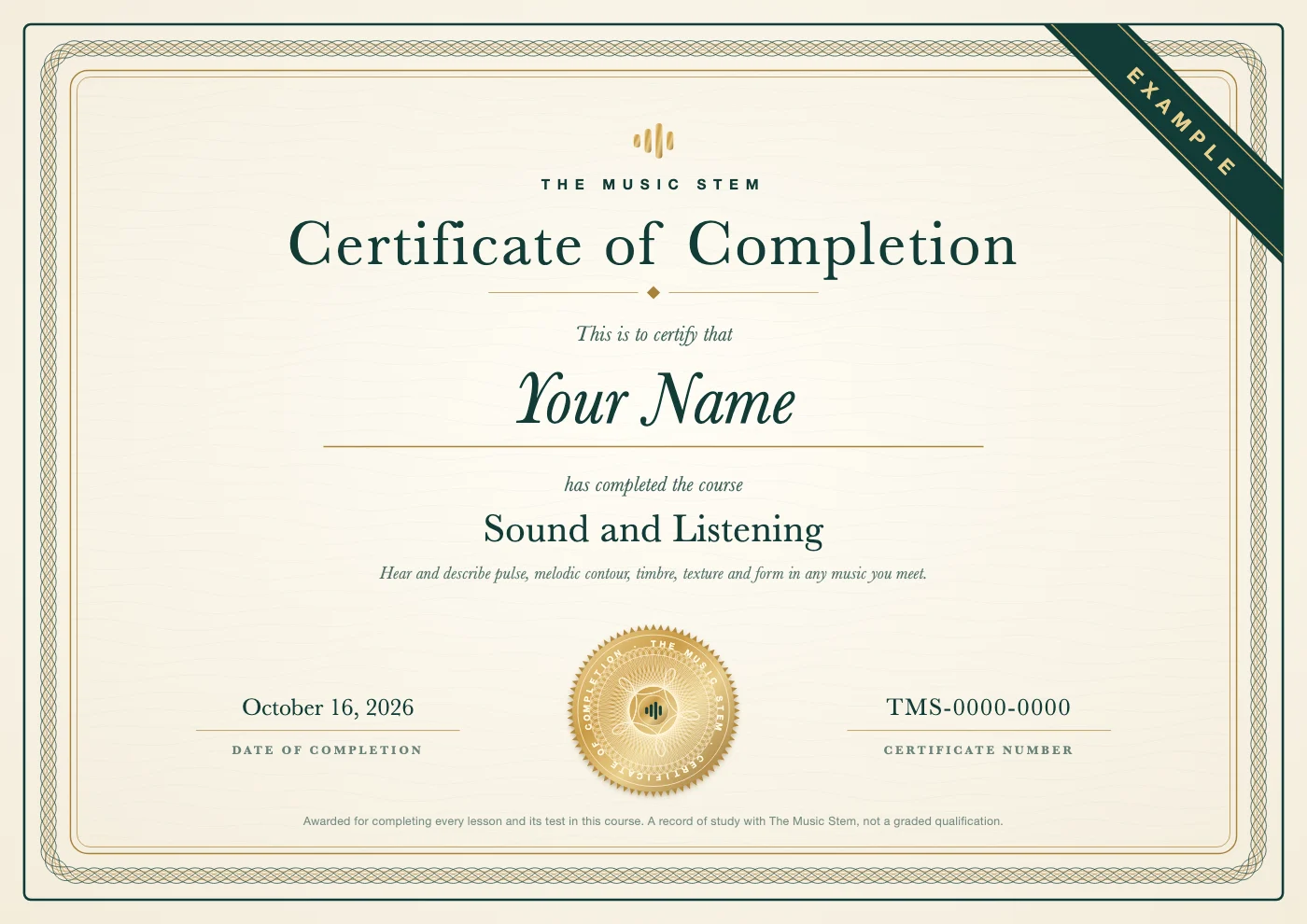
Each course on the site ends with a Certificate of Completion. You earn it when every lesson in the course is complete. You earn a Certificate of Practice for a full practice paper when you answer all its questions in Exam mode.
See the courses →Questions and answers
How long is the ABRSM Grade 5 Music Theory practice test?
Exam mode gives 2 hours for the whole practice test. It holds 75 questions. Study mode has no clock.
What sections does the ABRSM Grade 5 Music Theory practice test cover?
It follows the board's order in seven sections, from Rhythm to Music in Context.
Are the answers explained?
Yes. Each answer comes with an explanation of why it is correct.
More ABRSM practice tests
See a mistake on this page? Write to info@themusicstem.com or read how to report an error.